


 More vintage TV Guide clippings from my collection. Someone at ABC really liked that one Dirk Benedict publicity still, didn't they? "Boltar?"
 More vintage TV Guide clippings from my collection. Someone at ABC really liked that one Dirk Benedict publicity still, didn't they? "Boltar?"

 Gorgeous Wanda Ventham as the no-nonsense Colonel Virginia Lake on Gerry Anderson's UFO. In the second production block for the series, actor George Sewell didn't return to reprise his role as Colonel Alec Freeman for some reason, so the producers brought back the statuesque, blonde Ventham, who had appeared briefly in the pilot, to take his place as Commander Straker's No. 2 at SHADO.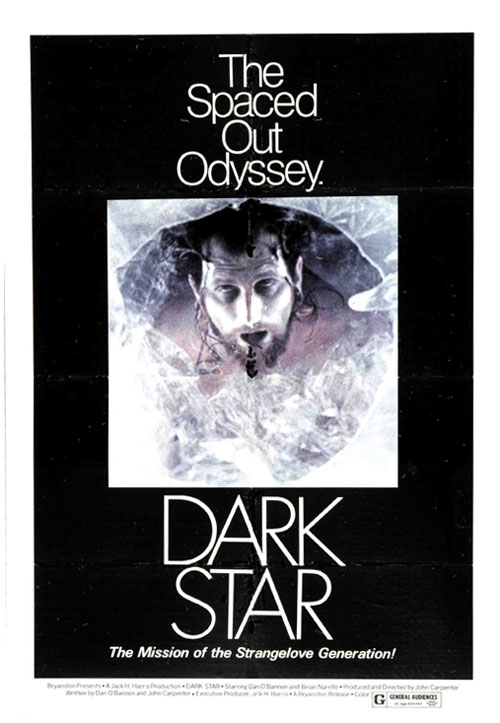
 While attending USC, students John Carpenter (Halloween, Escape From New York) and Dan O'Bannon (Return Of The Living Dead) produced a $60,000, 68-minute science fiction black comedy called Dark Star (1974). The film was picked up by producer Jack H. Harris (The Blob, Dinosaurus), who paid the young auteurs to film additional scenes and bring the running time to feature length.
 In an unspecified future time, the patrol ship Dark Star, with its crew of five - Dollittle (Brian Narelle), Boiler (Cal Kuniholm), Talby (Dre Pahich), Pinback (Dan O'Bannon) and the cryogenically frozen corpse of ship's Commander Powell - is on a mission to destroy unstable planets with artificially-intelligent "thermostellar" warheads. Unfortunately, the ship has been away from Earth for twenty years and is falling apart, damaged by meteors and plagued with system malfunctions. The crew isn't in much better shape - unkempt, neurotic, and apathetic. When one of the aforementioned malfunctions causes warhead #20 to threaten to explode and take the ship with it, Lieutenant Doolittle has to try and talk the bomb out of fulfilling its prime directive.
 Written by O'Bannon (who later co-wrote Alien) and Carpenter, and directed by Carpenter, Dark Star is a crudely crafted but ingenious science fiction film, executed with style, wit and humor. The comedy is of a decidedly dark variety - very 1970s - and the amateur cast isn't always up to the task of carrying it off, but there are plenty of chuckles to be had, especially during Sgt. Pinback's extended struggle with the ship's alien mascot - a beach ball with claws.
 VCI Entertainment offers two versions of Dark Star on its DVD. The theatrical version, and a shorter, "Special Edition," which purports to recreate the original student film. Both transfers are in 1.85 widescreen, with the "Special Edition" version looking slightly better than the theatrical. Both versions, though, are rather soft and dark, which is to be expected, considering the film was shot in 16mm. Both also show some wear & tear, but nothing egregious. Supplemental material is limited to the theatrical trailer and some text bios.
 Dark Star is an entertaining curio and fascinating look at the nascent talents of Carpenter, O'Bannon and their crew. It is extremely accomplished for a student film, and while it lacks the polish and production value of a big studio motion picture, it's easy to see why Carpenter and the late O'Bannon were able to go on to forge such impressive movie careers.
 There have been rumors of an improved special edition being in the works for several years, but no official announcement has been made. If you haven't seen Dark Star and are a science fiction fan or interested in Carpenter's work, you should at least try to find a copy to rent. The DVD's technical quality's not the greatest, but the film is definitely worth seeing.


Hi there Christopher,So, does this sound familiar to anyone out there?
I am writing to you from Germany and was wondering wether you could help me find a movie that I have been looking for - for, literally, ages.
One scene has stuck in my mind since childhood and has seen me scouring the web for an answer as to it's origins.
I don't recall at all what the story of the movie in general was about. It aired here in Germany during the late seventies and all I remember was that it was profoundly gripping and terrifying.
This is the scene that I remember:
The film was set in a strange future world, where two people were stuck in a hilly desolate landscape. The sun was setting and the rolling hills were lit by the late afternoon twilight.
The two characters were talking urgently and needed to get away from that spot to evade an 'enemy' or alien force, which was closing in on them. This 'enemy' had begun to appear on a broad front over a ridge behind our heroes. They were silver or white and had an egg-shaped or balloon-like appearance. There might have been ten or twenty of these creatures, which moved along in a nightmarish bouncing slow motion dance.
The balloon creatures could have been bobbing down the slope toward the sunset. The two heroes might have been near a shuttle-like vehicle.
Thank you ever so much for your time!

 Blackstar (1980-81) was probably the last Filmation cartoon I remember actually getting up early to watch. I was into D&D then, and anything with a sword & sorcery theme caught my interest. Unfortunately, if I recall correctly, it aired in the same timeslot as Ruby-Spears' superior Thundarr The Barbarian on another network, so unless Thundarr was a repeat, I usually opted for the post-Apocalyptic barbarian over the sword-slinging astronaut, John Blackstar.
 Loosely inspired by interplanetary romances like Edgar Rice Burroughs’ "John Carter of Mars" pulp stories, Blackstar tells of an American astronaut, who, after passing through a black hole, finds himself stranded on the primitive planet Sagar. The planet is ruled by the evil, Darth Vader-esque Overlord, and opposed by a motley band of freedom fighters, including the sorceress Mara, shape-shifter Klone, and seven pink "trobbits." John Blackstar somehow comes into possession of the Starsword (an adventure never related on the series), a mystic blade that can be combined with the Overlord’s Powersword to become the Powerstar – an ultimate weapon that the Overlord desperately covets.
 Watching it today as a 40+ adult, I find that Blackstar is actually somewhat better than I remembered. The animation still looks pretty slick and, oddly enough for a Filmation adventure show, uses very little, if any, rotoscoping. The character designs and background paintings are excellent, really selling the alien environment of planet Sagar. The scripts – mostly by animation and sci-fi veterans J. Michael Reeves (Batman - the Animated Series) and Marc Scott Zicree (Sliders) – are fun and fast paced. I still hate the little pink "trobbits," though, and prefer the episodes that play down their child-friendly antics.
 A few years back, before BCI/Eclipse went wherever it is defunct video labels go, they released the complete series on DVD. The full-frame transfers are excellent; the source material on Blackstar looks much better than the prints used on their previous Flash Gordon set, with bright colors and virtually no visible debris or damage. Extras include an informative booklet of liner notes, writer and producer commentaries on two episodes, on-screen interviews with many of the creators of the show, two image galleries, and "The Magic of Filmation" documentary.
 Back in the mid-90s, I was an editor at a short-lived and now-forgotten comic book company called Tekno*Comix. Their gimmick was publishing comics created by science fiction personalities, and their premiere title was Leonard Nimoy's Primortals. I wrote eleven issues of that comic, beginning with #3, and it was a great deal of fun - as well as a huge nerdy thrill, since I'd always been a fan of the actor and his portrayal of Spock on Star Trek.
 Figures. Almost to the moment that I revise and post my three year-old review of the Flash Gordon - Saviour Of the Universe Edition DVD to this blog, Universal announces that the exact same version - but in high definition - will be hitting the street in June on Blu-Ray Disc.
 from Amazon at that link now for less than twenty bucks.
