It's tough to find any vintage advertising or promotional material for 1973's The Starlost, the Canadian-produced, syndicated science fiction series created by Harlan "Cordwainer Bird" Ellison. Every once in a while, though, I stumble across something.... like this, for instance: This odd, Biblical-inspired, hand-drawn ad (presumably by someone at WMAQ) appeared in the Northern Indiana edition of TV Guide for the week of September 22-28, 1973.
And then, there's this one, featuring pen 'n ink portraits of lead Keir Dullea and his co-stars, Robin Ward and Gay Rowan. I'm not entirely certain of its provenance, but it clearly ran in a Canadian television listing magazine (did they have TV Guide in Canada in '73?).
Showing posts with label The Starlost. Show all posts
Friday, May 31, 2013
Saturday, July 28, 2012
Behind-The-Scenes Pix #23: THE STARLOST
Not the most exciting or dramatic of Behind-The-Scenes photos, I admit, but considering it's from the 1973 Canadian series, The Starlost, I was amazed to find it. I believe this is from the "Space Precinct" episode, and the cramped set really shows what limited resources the low budget production had at its disposal.
I've admitted before that I actually enjoy The Starlost for what it is. Sure, it's not the show it should have or could have been; Harlan Ellison's concept (while not especially original) had tons of potential for a thoughtful, episodic science fiction series. Unfortunately, the bitter reality of economics left that potential unfulfilled, though I'm not sure that any TV production company in '73 could have really pulled it off to Ellison's satisfaction. It is a shame that the Canadian producers couldn't find more writers with actual experience in sci-fi, or secure a bigger budget - but as nonsensical and cheap as it may be, I still enjoy watching episodes on DVD every once in a while.
Wednesday, April 18, 2012
THE STARLOST (1973) That Never Was
I frequently embark on Google safaris, looking for cool stuff to post on the site or images to illustrate the posts I write. In a recent search for material relating to the 1973 television series The Starlost (a show that I still possess an inexplicable affection toward), the image above turned up. Now, I was pretty sure that there had been no Starlost TV novelizations, but that image looked friggin' authentic, so I dug deeper into the labyrinthine depths of the interwebs.
I still haven't determined exactly where this faux book cover originated, but it is definitely a hoax. Still, as a graphic designer myself, I have to give the unknown Photoshop artist his props. The fonts, layout and cover copy text are all delightfully true to the publishing styles of the Seventies. The careful "distressing" of the image works really well, too, adding to the illusion that this is a scan of a vintage paperback cover.
And it's because it is so well done that I decided to share it here. I like to think of it as a glimpse into an alternate universe, where The Starlost was a "runaway hit television series," instead of the creative and commercial disappointment that it turned out to be in this reality....
I still haven't determined exactly where this faux book cover originated, but it is definitely a hoax. Still, as a graphic designer myself, I have to give the unknown Photoshop artist his props. The fonts, layout and cover copy text are all delightfully true to the publishing styles of the Seventies. The careful "distressing" of the image works really well, too, adding to the illusion that this is a scan of a vintage paperback cover.
And it's because it is so well done that I decided to share it here. I like to think of it as a glimpse into an alternate universe, where The Starlost was a "runaway hit television series," instead of the creative and commercial disappointment that it turned out to be in this reality....
Thursday, November 3, 2011
THE STARLOST (1973) TV Guide Ads
More vintage TV Guide ads! Here are a couple of advertisements for the syndicated, Canadian-produced 1973 series, The Starlost, starring 2001: A Space Odyssey's Keir Dullea and Gay Rowan. One of the most derided genre series of the Space: 1970 era, I'll admit that it's not a very good show. Still, I find the characters likable and the premise is certainly intriguing - even if rather poorly executed on a microscopic budget.
In fact, I may have to pull the DVD set down off the shelf again someday soon....
Monday, May 23, 2011
Space: 1970 Mythbusting
Since I started this blog back in November of 2009, I've received a number of e-mails and comments here and on the Facebook page that contain some misinformation about the 70s sci-fi movies and television shows we all love so much. In many cases, these are clearly just made-up rumors, probably originating in schoolyards thirty years ago. In others, they are perpetuations of errors originally published in fanzines or on websites.
In most cases, these "myths" can be disproven with minimum effort. And as long as that's the case, I'll be happy to disprove them! Here are a few that have actually come up more than once.
MYTH: The Ark vehicle from Filmation's Ark II television series was the repainted and modified Landmaster from the feature film Damnation Alley.
FACTS: I've encountered this myth in the comments section here, a couple of message boards, and at least one fansite. Here are the facts: Filmation's Ark II aired in the Fall of 1976 and was shot that Summer at various locations, including the Fox Ranch. The Ark vehicle was manufactured by the Brubaker Group and built on the chassis of a dump truck. The body was made up of fiberglass sections over a welded steel frame. Some of these sections - including the "nose," were recycled by Filmation to build the full-scale Seeker spaceship for their subsequent show, Space Academy. The vehicle was an empty shell, but did have a functioning ramp in the rear for the small, "Roamer" automobile - which was a modified "Brubaker Box" kit car, built on a Volkswagen bus chassis.
Damnation Alley was released to theaters in October, 1977, a full year after Ark II's debut. The Landmaster was built - at a reported $300,000-$350,000 - by famous custom cars man Dean Jeffries' company, which also built the vehicles for Death Race 2000 and the Logan's Run television series. The Landmaster, with its distinctive, "tri-star" 12-wheel configuration, was a functional (and road-legal) "truck." Although it did not appear on Ark II (which would have required time travel), it did appear in various other TV shows and movies, including Get A Life, Hybrid, and A.P.E.X.
And if none of that convinces you... a quick look at the two vehicles side-by-side above will clearly show that aside from being big, they don't look very similar at all.
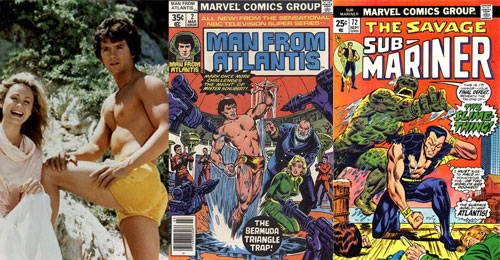
MYTH: Here's one about the Man From Atlantis television show - and subsequent comic book - I've heard more than once, most recently over on the Space: 1970 Facebook page, from reader Alex Mohalek:
But the story doesn't hold water (!) for one major reason - Man from Atlantis wasn't produced by Universal. It was independently produced by the Solow Production Company for NBC. My guess is that Marvel licensed the property for comics for the same reasons that they licensed Star Wars, Logan's Run, Godzilla and the Shogun Warriors - it seemed like something kids would like!
MYTH: Much like the Ark II/Damnation Alley item above, another frequently stated fan "myth" also involves alleged recycling of an important prop - in this case, the frequently-made allegation that the Canadian sci-fi series The Starlost used special effects genius Doug Trumbull's Valley Forge miniature from Silent Running as the basis for the Earthship Ark model.
FACTS: It's very easy to understand why people would believe this. Doug Trumbull (2001, CE3K) was initially supposed to supervise the effects work for The Starlost and was credited as a producer for the entire run of the series. He also appeared in a promotional film for the show with star Kier Dullea, and that promo film did use stock shots from Silent Running to show potential programmers what The Starlost's effects were going to look like. Plus, both the Valley Forge and the Earthship Ark feature large, geodesic domes prominently in their designs.
But... Trumbull was already off the show by the time production began in Canada, and while he may have been involved in the initial design of the Earthship Ark, as far as I can determine, he was not present when it was built and did not supervise its photography. The shapes of the two ships are significantly different, and the Starlost vessel has many, many interconnected domes while the Silent Running ship only had six (although several identical ships were seen in the film, only one model was actually built). The Valley Forge model was about 26 feet long, while the Ark was roughly half that length. Photos found online also show the detailing of the domes from Silent Running (left) and The Starlost (right), and the Ark model seems significantly less detailed (and smaller in scale) than the Valley Forge.
Now, that's just from observation. I cannot definitively state that there was absolutely no reuse of parts, but it sure seems unlikely. Undoubtedly the Valley Forge design influenced that of the Earthship Ark, but they were completely different models. Stock footage of the Silent Running model did show up on episodes of Battlestar Galactica as the fleet's "Agro-ship," but by that point, the original effects miniature no longer existed.
Whew. That required more detective work (and Googling) than I anticipated. Of course, it is possible that I may be in error myself with some of my deductions, and I'll happily correct any mistakes, if I receive credible information otherwise. Still, I think I'm right. Anyway, I may do more essays like this in the future. If you have suggestions, post them in the comments section.
In most cases, these "myths" can be disproven with minimum effort. And as long as that's the case, I'll be happy to disprove them! Here are a few that have actually come up more than once.
MYTH: The Ark vehicle from Filmation's Ark II television series was the repainted and modified Landmaster from the feature film Damnation Alley.
FACTS: I've encountered this myth in the comments section here, a couple of message boards, and at least one fansite. Here are the facts: Filmation's Ark II aired in the Fall of 1976 and was shot that Summer at various locations, including the Fox Ranch. The Ark vehicle was manufactured by the Brubaker Group and built on the chassis of a dump truck. The body was made up of fiberglass sections over a welded steel frame. Some of these sections - including the "nose," were recycled by Filmation to build the full-scale Seeker spaceship for their subsequent show, Space Academy. The vehicle was an empty shell, but did have a functioning ramp in the rear for the small, "Roamer" automobile - which was a modified "Brubaker Box" kit car, built on a Volkswagen bus chassis.
Damnation Alley was released to theaters in October, 1977, a full year after Ark II's debut. The Landmaster was built - at a reported $300,000-$350,000 - by famous custom cars man Dean Jeffries' company, which also built the vehicles for Death Race 2000 and the Logan's Run television series. The Landmaster, with its distinctive, "tri-star" 12-wheel configuration, was a functional (and road-legal) "truck." Although it did not appear on Ark II (which would have required time travel), it did appear in various other TV shows and movies, including Get A Life, Hybrid, and A.P.E.X.
And if none of that convinces you... a quick look at the two vehicles side-by-side above will clearly show that aside from being big, they don't look very similar at all.
MYTH: Here's one about the Man From Atlantis television show - and subsequent comic book - I've heard more than once, most recently over on the Space: 1970 Facebook page, from reader Alex Mohalek:
Universal didn't want to pay Marvel Comics for the rights to use "Prince Namor, The Sub-Mariner," so they made up their own undersea hero, as it was easier to have Patrick Duffy portray one water-breathing Atlantean instead of creating costumes, sets, special effects, to show an entire race of blue-skinned water-breathers. When Marvel heard of this, their legal department threatened to sue Universal, but that plan was nixed as Marvel and Universal already had joint ventures with the Spider-Man and Incredible Hulk television series, as well as failed pilots for Captain America and Doctor Strange. So, a deal was hammered out where Marvel would produced the comic based on the situations and characters in the series.FACTS: Now, I cannot say for certain whether Marvel ever considered suing over the Man From Atlantis show. Many companies feel that copyrights and trademarks need to be defended aggressively against any perceived infringement, even when there's not really all that much similarity. Mark Harris (Duffy's character on Man From Atlantis) didn't have pointed ears or winged ankles, and as there were other water-breathing superheroes around with Atlantean connections, I think it would have been difficult to prove any specific inspiration from Marvel's character. (In my opinion, the Mark Harris character more closely resembles Aquaman than Namor.)
But the story doesn't hold water (!) for one major reason - Man from Atlantis wasn't produced by Universal. It was independently produced by the Solow Production Company for NBC. My guess is that Marvel licensed the property for comics for the same reasons that they licensed Star Wars, Logan's Run, Godzilla and the Shogun Warriors - it seemed like something kids would like!
MYTH: Much like the Ark II/Damnation Alley item above, another frequently stated fan "myth" also involves alleged recycling of an important prop - in this case, the frequently-made allegation that the Canadian sci-fi series The Starlost used special effects genius Doug Trumbull's Valley Forge miniature from Silent Running as the basis for the Earthship Ark model.
FACTS: It's very easy to understand why people would believe this. Doug Trumbull (2001, CE3K) was initially supposed to supervise the effects work for The Starlost and was credited as a producer for the entire run of the series. He also appeared in a promotional film for the show with star Kier Dullea, and that promo film did use stock shots from Silent Running to show potential programmers what The Starlost's effects were going to look like. Plus, both the Valley Forge and the Earthship Ark feature large, geodesic domes prominently in their designs.
But... Trumbull was already off the show by the time production began in Canada, and while he may have been involved in the initial design of the Earthship Ark, as far as I can determine, he was not present when it was built and did not supervise its photography. The shapes of the two ships are significantly different, and the Starlost vessel has many, many interconnected domes while the Silent Running ship only had six (although several identical ships were seen in the film, only one model was actually built). The Valley Forge model was about 26 feet long, while the Ark was roughly half that length. Photos found online also show the detailing of the domes from Silent Running (left) and The Starlost (right), and the Ark model seems significantly less detailed (and smaller in scale) than the Valley Forge.
Now, that's just from observation. I cannot definitively state that there was absolutely no reuse of parts, but it sure seems unlikely. Undoubtedly the Valley Forge design influenced that of the Earthship Ark, but they were completely different models. Stock footage of the Silent Running model did show up on episodes of Battlestar Galactica as the fleet's "Agro-ship," but by that point, the original effects miniature no longer existed.
Whew. That required more detective work (and Googling) than I anticipated. Of course, it is possible that I may be in error myself with some of my deductions, and I'll happily correct any mistakes, if I receive credible information otherwise. Still, I think I'm right. Anyway, I may do more essays like this in the future. If you have suggestions, post them in the comments section.
Sunday, March 27, 2011
Rerun: THE STARLOST (1973)
(This is a re-post of an article originally posted in November of 2009.)
Like many other things in my life, I first discovered the existence of The Starlost through the pages of Starlog magazine in the mid-70's. I learned there that it had been a short-lived 1973 television series created by Harlan Ellison, who, dissatisfied by the final product, had chosen to use his pen name of "Cordwainer Bird" in the credits.
I also knew that Keir Dullea, of 2001: A Space Odyssey, played the lead role of Devon, a young Amish man who discovers that his small world of Cypress Corners is actually an artificial biosphere, one of many that make up the Earthship Ark – a vast multi-generation spacecraft. Venturing beyond his own artificial world, he discovers that a cataclysmic accident several hundred years before killed the command crew of the Ark, and it is now crippled and off-course, heading directly toward a star. With his friends Rachel (Gay Rowan) and Garth (Robin Ward), Devon searches the Ark for some way to correct the ship's course, or for someone knowledgeable enough save it and the millions of people isolated in their own biospheres – most of whom are unaware that they are on a spaceship at all.
And that was about it.
In the late 80's I came across a paperback copy of Phoenix Without Ashes, Edward Bryant's novelization of Ellison's original pilot script for the series. The introduction to the book – by Ellison himself – detailed the series' troubled production and the reasons for the acclaimed author's unhappiness with the show. The novel was pretty good, and piqued my interest, but as the series had only run for 16 episodes and was virtually unseen in syndication, I figured I'd never see the show. Which disappointed me, because I love 70's sci-fi television, no matter how bad its reputation.
Well, considering all the obscurities that have been dug up and released on DVD in the last decade, I should have guessed that somebody would put it on digital disc eventually, and sure enough, the folks at VCI Entertainment have done just that. All 16 episodes of the Canadian-produced show are now available on a compact, 4-disc set.
Produced on a very small budget, the show was shot on videotape and featured modular sets that could be disassembled and reassembled in different configurations to suggest new sections of the vast Earthship Ark. There was also extensive use of chromakey (bluescreen), which enabled the production team to drop the actors "into" miniature sets, which saved even more money. Too bad most of the miniatures were pretty unconvincing.
The videotape filming, sets and costumes give the series a look similar to Doctor Who episodes of the same vintage, but The Starlost doesn't have the same charismatic characters or ambitious storylines and unbridled imagination of Who. In fact, it's pretty mundane all around.
The stories started out okay – if overly cliched – but soon devolved into silliness, with the sort of ludicrous faux science that was common in the era's sci-fi TV. And that's a real shame since some decent guest stars appeared on the show, including familiar genre faces John Colicos (the original Battlestar Galactica, Star Trek), Barry Morse (Space: 1999), Simon Oakland (Kolchak: The Night Stalker), and Walter Koenig (Star Trek, Babylon 5).
Still, I found myself growing somewhat fond of Devon, Garth and Rachel, and I thought that most of the episodes were - at least - entertaining.
Nonetheless, I can completely understand why Ellison disowned the show, and why noted science fiction writer Ben Bova was embarrassed to be credited as the series' "science advisor" – he was completely ignored by the producers, but they kept his name in the credits for the publicity value. Same with special effects ace Douglas Trumbull (2001, Silent Running, Close Encounters of the Third Kind), who quit the show before the first episode was shot, but remained credited as a producer for the entire run.
VCI's DVD set includes all 16 episodes on 4 discs, packed into one standard-sized case. The transfers are sharp and clean, but as noted above, the show was shot on videotape, so the picture quality is far from perfect, with some minor video "noise" and some bleeding colors. It's probably better than it looked on TV in '73, though. The only extra is a presentation reel used to pitch the syndicated series to independent stations before production, hosted by Dullea and Trumbull. In this short film, the series is verbally described by Dullea, accompanied by stock effects shots from Trumbull's then-recent feature, Silent Running.
The Starlost is a classic missed opportunity – with Ellison, Bova and Trumbull aboard, it should have been something remarkable, and revolutionary. Unfortunately, the realities of independent television production, and the bad judgment of the producers resulted instead in an artistic and commercial misfire, interesting only to die hard fans of 70's genre television like myself.
If you consider yourself such a fan, then VCI's set is worth checking out. Buy it from Amazon here: The Starlost - The Complete Series
Like many other things in my life, I first discovered the existence of The Starlost through the pages of Starlog magazine in the mid-70's. I learned there that it had been a short-lived 1973 television series created by Harlan Ellison, who, dissatisfied by the final product, had chosen to use his pen name of "Cordwainer Bird" in the credits.
I also knew that Keir Dullea, of 2001: A Space Odyssey, played the lead role of Devon, a young Amish man who discovers that his small world of Cypress Corners is actually an artificial biosphere, one of many that make up the Earthship Ark – a vast multi-generation spacecraft. Venturing beyond his own artificial world, he discovers that a cataclysmic accident several hundred years before killed the command crew of the Ark, and it is now crippled and off-course, heading directly toward a star. With his friends Rachel (Gay Rowan) and Garth (Robin Ward), Devon searches the Ark for some way to correct the ship's course, or for someone knowledgeable enough save it and the millions of people isolated in their own biospheres – most of whom are unaware that they are on a spaceship at all.
And that was about it.
In the late 80's I came across a paperback copy of Phoenix Without Ashes, Edward Bryant's novelization of Ellison's original pilot script for the series. The introduction to the book – by Ellison himself – detailed the series' troubled production and the reasons for the acclaimed author's unhappiness with the show. The novel was pretty good, and piqued my interest, but as the series had only run for 16 episodes and was virtually unseen in syndication, I figured I'd never see the show. Which disappointed me, because I love 70's sci-fi television, no matter how bad its reputation.
Well, considering all the obscurities that have been dug up and released on DVD in the last decade, I should have guessed that somebody would put it on digital disc eventually, and sure enough, the folks at VCI Entertainment have done just that. All 16 episodes of the Canadian-produced show are now available on a compact, 4-disc set.
Produced on a very small budget, the show was shot on videotape and featured modular sets that could be disassembled and reassembled in different configurations to suggest new sections of the vast Earthship Ark. There was also extensive use of chromakey (bluescreen), which enabled the production team to drop the actors "into" miniature sets, which saved even more money. Too bad most of the miniatures were pretty unconvincing.
The videotape filming, sets and costumes give the series a look similar to Doctor Who episodes of the same vintage, but The Starlost doesn't have the same charismatic characters or ambitious storylines and unbridled imagination of Who. In fact, it's pretty mundane all around.
The stories started out okay – if overly cliched – but soon devolved into silliness, with the sort of ludicrous faux science that was common in the era's sci-fi TV. And that's a real shame since some decent guest stars appeared on the show, including familiar genre faces John Colicos (the original Battlestar Galactica, Star Trek), Barry Morse (Space: 1999), Simon Oakland (Kolchak: The Night Stalker), and Walter Koenig (Star Trek, Babylon 5).
Still, I found myself growing somewhat fond of Devon, Garth and Rachel, and I thought that most of the episodes were - at least - entertaining.
Nonetheless, I can completely understand why Ellison disowned the show, and why noted science fiction writer Ben Bova was embarrassed to be credited as the series' "science advisor" – he was completely ignored by the producers, but they kept his name in the credits for the publicity value. Same with special effects ace Douglas Trumbull (2001, Silent Running, Close Encounters of the Third Kind), who quit the show before the first episode was shot, but remained credited as a producer for the entire run.
VCI's DVD set includes all 16 episodes on 4 discs, packed into one standard-sized case. The transfers are sharp and clean, but as noted above, the show was shot on videotape, so the picture quality is far from perfect, with some minor video "noise" and some bleeding colors. It's probably better than it looked on TV in '73, though. The only extra is a presentation reel used to pitch the syndicated series to independent stations before production, hosted by Dullea and Trumbull. In this short film, the series is verbally described by Dullea, accompanied by stock effects shots from Trumbull's then-recent feature, Silent Running.
The Starlost is a classic missed opportunity – with Ellison, Bova and Trumbull aboard, it should have been something remarkable, and revolutionary. Unfortunately, the realities of independent television production, and the bad judgment of the producers resulted instead in an artistic and commercial misfire, interesting only to die hard fans of 70's genre television like myself.
If you consider yourself such a fan, then VCI's set is worth checking out. Buy it from Amazon here: The Starlost - The Complete Series
Thursday, February 3, 2011
February's Space Babe: Gay Rowan
February's Space Babe is the lovely Gay Rowan as Rachel, from the 1973, Canadian-produced television series The Starlost. As a member of an Amish-like community who follows the man she loves into exile, forced to face the startling revelation that her world is just an artificial biosphere - one of many - on a gigantic space ark, Rowan's Rachel always exhibited a sense of wonder, a warm heart, and admirable bravery... all of which made her extremely appealing. The scripts and production values didn't usually give her or her co-stars (Keir Dullea and Robin Ward) much of an opportunity to showcase their talent, but Rowan was always likeable and came off well.
The Canadian actress was born in 1948 and had a few small roles in Canadian and American TV series for about ten years ('73-'83), but as far as I (and the IMDb) can tell, The Starlost seems to have been her only regular series role, and she hasn't made any film or TV appearances in almost 30 years. It's too bad. As I mentioned above, she was a very appealing young woman, pretty and intelligent, and deserved a bigger career. I wonder what became of her?
Friday, November 19, 2010
THE STARLOST (1973) Movie: "The Beginning"
Like many other sci-fi shows from the era (Battlestar Galactica, Planet of the Apes, Space: 1999) several episodes of the Canadian series The Starlost, were also edited into TV movies for syndication. Apparently these cobbled-together telefilms didn't get much airplay in the U.S., but ran for years and years in Canada.
This is the opening narration and credits for the first of these, "The Beginning," which incorporated the episodes "Voyage of Discovery" and "The Goddess Calabra," which guest starred Space: 1970 favorites John Colicos and Barry Morse!
Monday, November 2, 2009
THE STARLOST (1973)
Like many other things in my life, I first discovered the existence of The Starlost through the pages of Starlog magazine in the mid-70's. I learned there that it had been a short-lived 1973 television series created by Harlan Ellison, who, dissatisfied by the final product, had chosen to use his pen name of "Cordwainer Bird" in the credits.
I also knew that Keir Dullea, of 2001: A Space Odyssey, played the lead role of Devon, a young Amish man who discovers that his small world of Cypress Corners is actually an artificial biosphere, one of many that make up the Earthship Ark – a vast multi-generation spacecraft. Venturing beyond his own artificial world, he discovers that a cataclysmic accident several hundred years before killed the command crew of the Ark, and it is now crippled and off-course, heading directly toward a star. With his friends Rachel (Gay Rowan) and Garth (Robin Ward), Devon searches the Ark for some way to correct the ship's course, or for someone knowledgeable enough save it and the millions of people isolated in their own biospheres – most of whom are unaware that they are on a spaceship at all.
And that was about it.
In the late 80's I came across a paperback copy of Phoenix Without Ashes, Edward Bryant's novelization of Ellison's original pilot script for the series. The introduction to the book – by Ellison himself – detailed the series' troubled production and the reasons for the acclaimed author's unhappiness with the show. The novel was pretty good, and piqued my interest, but as the series had only run for 16 episodes and was virtually unseen in syndication, I figured I'd never see the show. Which disappointed me, because I love 70's sci-fi television, no matter how bad its reputation.
Well, considering all the obscurities that have been dug up and released on DVD in the last decade, I should have guessed that somebody would put it on digital disc eventually, and sure enough, the folks at VCI Entertainment have done just that. All 16 episodes of the Canadian-produced show are now available on a compact, 4-disc set.
Produced on a very small budget, the show was shot on videotape and featured modular sets that could be disassembled and reassembled in different configurations to suggest new sections of the vast Earthship Ark. There was also extensive use of chromakey (bluescreen), which enabled the production team to drop the actors "into" miniature sets, which saved even more money. Too bad most of the miniatures were pretty unconvincing.
The videotape filming, sets and costumes give the series a look similar to Doctor Who episodes of the same vintage, but The Starlost doesn't have the same charismatic characters or ambitious storylines and unbridled imagination of Who. In fact, it's pretty mundane all around.
The stories started out okay – if overly cliched – but soon devolved into silliness, with the sort of ludicrous faux science that was common in the era's sci-fi TV. And that's a real shame since some decent guest stars appeared on the show, including familiar genre faces John Colicos (the original Battlestar Galactica, Star Trek), Barry Morse (Space: 1999), Simon Oakland (Kolchak: The Night Stalker), and Walter Koenig (Star Trek, Babylon 5).
Still, I found myself growing somewhat fond of Devon, Garth and Rachel, and I thought that most of the episodes were - at least - entertaining.
Nonetheless, I can completely understand why Ellison disowned the show, and why noted science fiction writer Ben Bova was embarrassed to be credited as the series' "science advisor" – he was completely ignored by the producers, but they kept his name in the credits for the publicity value. Same with special effects ace Douglas Trumbull (2001, Silent Running, Close Encounters of the Third Kind), who quit the show before the first episode was shot, but remained credited as a producer for the entire run.
VCI's DVD set includes all 16 episodes on 4 discs, packed into one standard-sized case. The transfers are sharp and clean, but as noted above, the show was shot on videotape, so the picture quality is far from perfect, with some minor video "noise" and some bleeding colors. It's probably better than it looked on TV in '73, though. The only extra is a presentation reel used to pitch the syndicated series to independent stations before production, hosted by Dullea and Trumbull. In this short film, the series is verbally described by Dullea, accompanied by stock effects shots from Trumbull's then-recent feature, Silent Running.
The Starlost is a classic missed opportunity – with Ellison, Bova and Trumbull aboard, it should have been something remarkable, and revolutionary. Unfortunately, the realities of independent television production, and the bad judgment of the producers resulted instead in an artistic and commercial misfire, interesting only to die hard fans of 70's genre television like myself.
If you consider yourself such a fan, then VCI's set is worth checking out. Buy it from Amazon here: The Starlost - The Complete Series
I also knew that Keir Dullea, of 2001: A Space Odyssey, played the lead role of Devon, a young Amish man who discovers that his small world of Cypress Corners is actually an artificial biosphere, one of many that make up the Earthship Ark – a vast multi-generation spacecraft. Venturing beyond his own artificial world, he discovers that a cataclysmic accident several hundred years before killed the command crew of the Ark, and it is now crippled and off-course, heading directly toward a star. With his friends Rachel (Gay Rowan) and Garth (Robin Ward), Devon searches the Ark for some way to correct the ship's course, or for someone knowledgeable enough save it and the millions of people isolated in their own biospheres – most of whom are unaware that they are on a spaceship at all.
And that was about it.
In the late 80's I came across a paperback copy of Phoenix Without Ashes, Edward Bryant's novelization of Ellison's original pilot script for the series. The introduction to the book – by Ellison himself – detailed the series' troubled production and the reasons for the acclaimed author's unhappiness with the show. The novel was pretty good, and piqued my interest, but as the series had only run for 16 episodes and was virtually unseen in syndication, I figured I'd never see the show. Which disappointed me, because I love 70's sci-fi television, no matter how bad its reputation.
Well, considering all the obscurities that have been dug up and released on DVD in the last decade, I should have guessed that somebody would put it on digital disc eventually, and sure enough, the folks at VCI Entertainment have done just that. All 16 episodes of the Canadian-produced show are now available on a compact, 4-disc set.
Produced on a very small budget, the show was shot on videotape and featured modular sets that could be disassembled and reassembled in different configurations to suggest new sections of the vast Earthship Ark. There was also extensive use of chromakey (bluescreen), which enabled the production team to drop the actors "into" miniature sets, which saved even more money. Too bad most of the miniatures were pretty unconvincing.
The videotape filming, sets and costumes give the series a look similar to Doctor Who episodes of the same vintage, but The Starlost doesn't have the same charismatic characters or ambitious storylines and unbridled imagination of Who. In fact, it's pretty mundane all around.
The stories started out okay – if overly cliched – but soon devolved into silliness, with the sort of ludicrous faux science that was common in the era's sci-fi TV. And that's a real shame since some decent guest stars appeared on the show, including familiar genre faces John Colicos (the original Battlestar Galactica, Star Trek), Barry Morse (Space: 1999), Simon Oakland (Kolchak: The Night Stalker), and Walter Koenig (Star Trek, Babylon 5).
Still, I found myself growing somewhat fond of Devon, Garth and Rachel, and I thought that most of the episodes were - at least - entertaining.
Nonetheless, I can completely understand why Ellison disowned the show, and why noted science fiction writer Ben Bova was embarrassed to be credited as the series' "science advisor" – he was completely ignored by the producers, but they kept his name in the credits for the publicity value. Same with special effects ace Douglas Trumbull (2001, Silent Running, Close Encounters of the Third Kind), who quit the show before the first episode was shot, but remained credited as a producer for the entire run.
VCI's DVD set includes all 16 episodes on 4 discs, packed into one standard-sized case. The transfers are sharp and clean, but as noted above, the show was shot on videotape, so the picture quality is far from perfect, with some minor video "noise" and some bleeding colors. It's probably better than it looked on TV in '73, though. The only extra is a presentation reel used to pitch the syndicated series to independent stations before production, hosted by Dullea and Trumbull. In this short film, the series is verbally described by Dullea, accompanied by stock effects shots from Trumbull's then-recent feature, Silent Running.
The Starlost is a classic missed opportunity – with Ellison, Bova and Trumbull aboard, it should have been something remarkable, and revolutionary. Unfortunately, the realities of independent television production, and the bad judgment of the producers resulted instead in an artistic and commercial misfire, interesting only to die hard fans of 70's genre television like myself.
If you consider yourself such a fan, then VCI's set is worth checking out. Buy it from Amazon here: The Starlost - The Complete Series
Subscribe to:
Posts (Atom)