Friday, February 12, 2010

25th Century Perspectives

I've been looking back through some of my old Starlog magazines from the 70s, and earlier today I ran across a couple of articles from early 1980, where the cast and producers of Buck Rogers in the 25th Century were enthusiastically discussing the changes that were being made in the show for its second season. Everyone involved - it appears - were certain that these changes were all positive and would result in a much-improved and more popular program.

Today, though, many - if not most - of us who remember the show regard the second season as a giant disappointment, with virtually all the charm and comic book fun of the first year drained away and replaced with ill-conceived, sub-Trek storylines, reduced production values, a dull, "serious" Gil Gerard (who apparently never realized that it was his charm and humor that were his strengths as a performer) and - perhaps worse of all - a tragically diminished and, frankly, demeaning, new role for Erin Gray's Wilma Deering. Without so much as an ounce of evident shame, the producers reduced her from a competent, intelligent woman of action to glorified telephone operator (I think - did they ever actually establish her position on the Searcher definitively?) in an absurd, unflattering carhop uniform.

But, to go back and read these old Starlog articles, it looks like this was exactly what the people in charge - and in the cast - wanted. Gerard wanted to show that he was a serious, thoughtful actor in stories that were about "ideas," and Gray wanted her role to be more feminine and less butch. (I wonder if she'd seen that ludicrous sailor suit yet?) Both praised the arrival of new producer John Mantley, whose past experience on Gunsmoke was supposed to be evidence of his mastery of characterization and drama, if not (as we soon learned) science fiction-fantasy.

Of course, Gerard had been difficult since the beginning, giving the impression that the comic strip-styled action-adventure nature of the show, with its scene-stealing robots, bright colors and scantily-clad female guest stars, were beneath him. It's a shame that he couldn't grasp just how unique that was, and how entertaining that approach could be.

In fact, the first season's "James Bond in space" format was something we hadn't seen before on television. The idea that this guy from our time era had an edge over all those futuristic villains because he knew how to rely on his own wits, intelligence, reflexes and experience was extremely appealing to young audiences. The "mission" format opened up the show to a variety of action-driven stories, and the relationships between the characters were all presented as being based on mutual respect. Buck appreciated Wilma as his guide to his new world and as a professional, respected Huer's sense of duty and basic humanity, and treated TWIKI as a valued friend. They, in turn, recognized that he brought something new and important to their time with his individuality and self-reliance, and could accomplish things that they could not.

And they laughed, and enjoyed each other's company.

The first season was light and the stories were unabashedly goofy (though, usually in a good way), but it was a future that was fun to visit once a week, with a hero that kids could look up to.

All of that was lost in the second year, with its half-baked format that stole equally from Star Trek and Battlestar Galactica, an uninspired and recycled spaceship model (from Season 1's "Cruise Ship to the Stars"), and hastily repainted and cobbled-together sets (Hint for SF television producers: if you're going to set your show on a single vessel week after week, make it distinctive and cool in its own right, instead of a random jumble of reused flats and rented computer props leftover from the 60s,awkwardly positioned so as to hide the seams. See Star Trek, Voyage to the Bottom of the Sea, Battlestar Galactica, Farscape, Firefly, etc).

The introduction of avian alien Hawk (an absurdly improbable concept, though well-played by Thom Christopher) changed it into more of a "buddy" show, giving Buck another male to adventure with, while Wilma stayed safely back on the ship, since women - even in John Mantley's 25th Century - really have no place in adventure stories, except to stay home, worry about their men, and make coffee.

The rest of the new supporting cast - Admiral Asimov (poor Isaac!), Doctor Goodfellow (an absent-minded scientist? Yeah, that's who I want as science officer on my starship - and gee, what a fresh idea!), and Crichton the obnoxious robot (yet another recycled prop) - were nothing but stock cyphers who were inexplicably subservient to their civilian passenger. Not one of them was given a consistent personality, with Asimov (for example) vacillating wildly between abrasive and confrontational to acquiescent and impotent -- sometimes in the same episode!

As for the scripts, well, they're what you'd expect the producer of Gunsmoke to think was science fiction, undercooked plots that would have been rejected by Star Trek, executed blandly. I'm sure part of that was Universal's cost-cutting, but still. One episode, "The Satyr," was literally recycled - it's basically the same script as Battlestar Galactica's "The Lost Warrior" and would reappear again as Tales of the Gold Monkey's "The Lady And The Tiger." I guess Universal wanted to get their money's worth out of that blatant Shane rip-off.

Here's the thing: the idea of making the show more serious and giving Buck more depth as a character - that's actually pretty smart, and might have made an entertaining show. But the way it was done - which was just completely inept - only killed the series that much faster.

It's all history now, and I have no idea if the principals involved - Mantley, Gerard, Gray, et al - see that second season as the disaster that I, and many other fans, do. Maybe they think that it's the better of the two seasons. I don't happen to agree, and what do I know? I was just a loyal viewer who missed the confident, wisecracking hero, scantily-clad female guest stars (Markie Post!) and Mel Blanc's TWIKI characterization.

The second season's not a total waste - I think three of the 13 episodes very nearly work (for the record: "Mark of the Saurian," "Testimony of a Traitor," and "The Dorian Secret."), but none of them are as simply entertaining as the majority of the first season. Hell, even "Cosmic Whiz Kid" is kinda charming, in a pandering sort of way. It's just sort of a shame that the people involved didn't recognize what actually worked about the show, and put so much effort into eliminating those aspects completely in its second year.

Obviously, I think way too much about this stuff.

SILENT RUNNING (1972) Theatrical Posters

I'm not sure why I have Silent Running on the brain this month - I haven't seen it in years, and it's one of the few 70s science fiction films I don't own on DVD or VHS. It's also quite different from most of the era's other genre films that I reminisce about here, as it's a pretty heavy, downbeat flick, rather than a shoot-em-up space opera.

Still, I've always liked the film, especially Douglas Trumbull's classic special effects and the robotic "drones" - and when I came across these one-sheets, it made me want to watch it again. I'll have to see if I can find a cheap copy of the DVD - or maybe I'll just check if it's available to rent from Netflix. (It is - I just checked!)

Sunday, January 31, 2010

News: STARCRASH and BATTLE BEYOND THE STARS on DVD in September

According to a report at DVD Drive-In, two of the announced titles in Shout! Factory's new arrangement with legendary exploitation film producer Roger Corman are new DVD and Blu-Ray special editions of Starcrash and Battle Beyond The Stars - both of which are due in the U.S. on September 7, 2010.

Since these are authorized editions and Shout! will have access to the Corman film library - and, presumably, master prints and/or negatives - I expect that these will be high quality transfers. Also, Shout! has a very good reputation for really going the extra mile on their releases both technically and in terms of supplements.

Both titles have been released before (there was an authorized version of Battle from Corman's New Horizons video, with a decent array of extras but a non-anamorphic, fairly-beat-up looking transfer, and various bootleg versions of Starcrash are floating around out there from different outfits, none of which look very good) but I expect these editions to blow those away.

I'll keep people posted as more information becomes available.

Monday, January 25, 2010

At Last! Beyond the Movie! Beyond the Galaxy!

I was thinking about Marvel's Star Wars comics from the 70's today, and remembering how much fun they were. Of course, this was before Lucasfilm really had their vampiric death grip on the licensing, sucking out all the joy and adventure that Star Wars should have and replacing it with an obsessive, convoluted and restrictive continuity. And though these books are kinda sneered at by today's Star Wars fans for being cheesy (this issue kicked off a six-part take-off of The Magnificent Seven* with one of the mercs being a 6' green space rabbit), I always thought cheesiness was part of the franchise's charm ("Luke Skywalker?").

Anyway, I have very fond memories of buying this series – and this issue – at the local corner store. Writers Roy Thomas and (especially) the late Archie Goodwin, spun some sublimely sweet space opera back in the day, and I still love 'em. Fortunately Dark Horse Comics reprinted the entire Marvel run in some nice trade paperbacks, so I can read them over and over again.

* I wonder if this is was where Roger Corman and John Sayles got the idea for their 1980 Star Wars rip-off, Battle Beyond The Stars, which also used The Magnificent Seven as its story template?

Thursday, January 21, 2010

Run Logan, Run

Starting in February, I'm going to start posting episode reviews of the Logan's Run television series from 1977. I have roughly two-thirds of the series here from old VHS recordings, and will be watching and writing up my thoughts on those shows here as a regular feature.

When I was a kid, I was a big fan of the TV series and the movie, which I have very clear memories of watching when it aired on network television. I even started to write my own "novelization" of the film, which I abandoned only after I found out there already was a book. Of course, the book was so different from the movie that I was both confused and a little angry.

Nowadays, I have great admiration for the trilogy of novels by William F. Nolan (who I've had the great fortune to correspond with in the past) and George Clayton Johnson (co-writer of the original novel).

Anyway, while I dread the prospect of a new Hollywood remake (which seems to be constantly under discussion), at least that would mean there would be a good chance of getting the TV series released on disc. And I'd like that.

Look for my Logan's Run reviews to begin in a couple weeks.

Monday, January 18, 2010

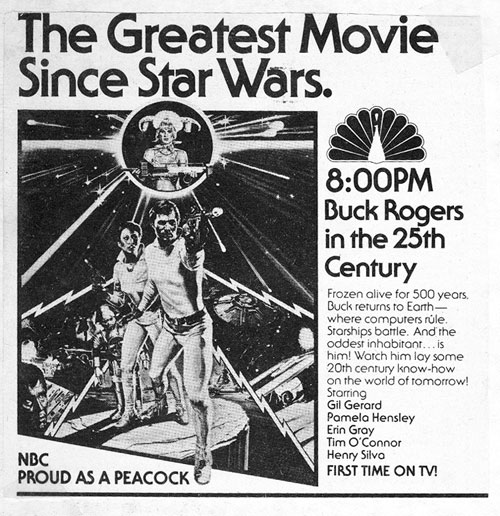
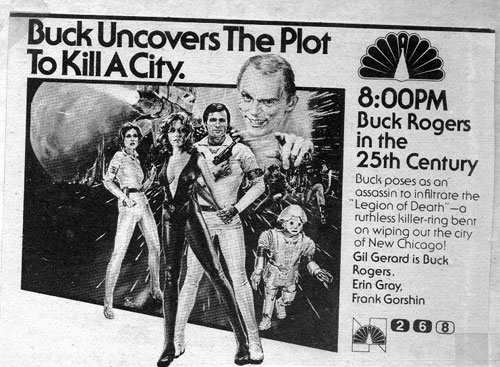
BUCK ROGERS TV Guide Advertisements

From my own collection, here are some of the ads that NBC whipped up for TV Guide magazine to promote Buck Rogers In The 25th Century back in 1979. I had forgotten that the network had aired a re-edited version of "Plot To Kill A City" as a 90 minute movie (Death Squad 2500) and that "Flight Of The War Witch" was originally broadcast as a two-hour special.

Click on the images above for a larger view. I've got a bunch of other TV Guide ads from the era, as well, and will be posting them here periodically. Enjoy the blast from the past!

Saturday, January 16, 2010

Space Babes: Patricia & Cyb Barnstable

Patricia and Cyb Barnstable as Betty 1 and Betty 2 on Quark. This month's Space Babes are the former Doublemint twins who played the ship's shapely pilot and equally shapely copilot, Betty, on the short-lived but much-loved sci-fi spoof created by Buck Henry in 1977. One Betty was real, the other her clone, but each claimed to be the original, and since they were identical....

The lovely Barnstable twins have very few film or television acting credits outside of commercials, talk shows and such, but these days, the former models are founders of a charity that raises money for diabetes research.

Starting this month, Space Babes will be a monthly feature - at one a week, I was burning through the decade's interstellar sirens far too quickly.

Thursday, January 14, 2010

Tuesday, January 12, 2010

FLASH GORDON (1979)

The success of Star Wars in 1977, along with George Lucas’ admitted indebtedness to 30’s serials and comic strips, inevitably led to other entrepreneurial filmmakers turning to those Depression-era sci-fi classics and characters, and reimagining them (though that noxious term hadn’t been invented yet) for the 1970s. Among these was another Filmation Saturday morning favorite, the animated Flash Gordon series from 1979-80.

When the rogue planet Mongo enters our solar system on a collision course for Earth, scientific genius Dr. Hans Zarkov, athlete Flash Gordon, and his girlfriend Dale Arden blast off in a rocketship of the doctor’s invention, hoping to find a way to turn the alien planet from its course. Crash landing on its surface, they find Mongo inhabited by a vast array of sentient creatures, all under the rule of the tyrannical Ming the Merciless. It soon becomes clear to the Earthmen (and Earthwoman) that the only hope of saving Earth lies in uniting the distrustful, ever-warring races of Mongo against the sinister space tyrant.

I have to say, that in my book, this show (first season only) is right up there with Jonny Quest, Thundarr the Barbarian and Batman the Animated Series among the great animated adventure shows. By Filmation standards, the animation is rather lush, with lots of rotoscoping and elaborate backgrounds and character designs. Being a limited-budget, limited-animation product of the Seventies, there’s the usual relentless recycling of footage and repetitive music cues, but it is executed with a level of care and ingenuity that is rare in cartoon shows of this vintage.

In the first season episodes, the writing is not dumbed down for kids and follows the continuity of the original Alex Raymond comic strips quite faithfully. Characters are actually killed (disintegrated) on-screen, and the female characters are designed to be blatantly sexy. Ming’s got his harem and King Vultan’s got dancing slave girls… there’s no way they would have been able to get away with that even a few years later in the 80s.

The first season is presented as an ongoing serial with cliffhangers, modeled after the classic Flash theatrical features from the 30s. The second season, however, is made up of 16 fifteen-minute segments that are, unfortunately, aimed squarely at extremely young children, with simpler, sillier stories and the addition to the cast of a pink baby dragon called Gremlin. The second season episodes are hardly worth watching, as the stories are too short to be very interesting and so much footage is recycled from Season 1 – and sloppily so, I might add – that the viewing experience is hollow.

Once again, BCI (under their Ink and Paint label) and animation expert Andy Mangels have put together a very nice DVD set. While the episodes definitely show their age, with a considerable amount of visible dirt and debris (inherent in this kind of animation) and somewhat faded colors, there are no noticeable digital artifacts or compression problems, and the audio is sharp and clear. The picture quality’s not perfect, but better than I expected after nearly 30 years.

There are some great extras included – a 20 minute documentary wherein Filmation head honcho Lou Scheimer and other studio staffers reminisce about the show and the TV feature that preceded it (production-wise; it had its sole airing after the series). There are character model sheets, some storyboards, the series bible and some scripts on DVD-ROM, and even the entire first episode of the 1980’s syndicated series Defenders of the Earth. This 80’s series (also released by BCI on DVD) also starred Flash Gordon, along with other characters owned by the Hearst Syndicate: The Phantom, Mandrake the Magician, his sidekick Lothar and their teenage children, all teaming up to battle Ming. The premise was okay, but looked and sounded like every other show that Marvel Productions made in the 80s: bland. Also inserted into the set are a fold out episode guide and two collectible art cards featuring beautiful illustrations by comic book artists Frank Cho and Gene Ha.

Unfortunately, the DVD set does not include the prime time TV movie that preceded the series, Flash Gordon: The Greatest Adventure of All. The feature-length movie was made by the same team, but was somewhat more adult in tone and story; whereas the TV series began with Flash and company landing on Mongo, the film begins in 1939 Warsaw under attack by the Nazis.

Flash escapes from the besieged city, and we follow him as he meets Dale (above) and Zarkov. Some animation from the feature was recycled and used in the subsequent Saturday morning series, but not nearly as much as people seem to think. The feature aired only once, a couple years after the series, and – inexcusably – has never been made available legally on home video, and that’s too bad, because it is a superior animated adventure.

Overall, I feel that the first season of the Filmation Flash Gordon is one of the best adaptations of the character to film (right up there with the Buster Crabbe serials of the Thirties), and one of the very best animated adventure series ever. But then, it’s pretty obvious from my other posts that I have an extremely strong bias toward the sci-fi efforts of the Filmation studio.

In 1980, Italian film mogul Dino deLaurentis released a live-action Flash Gordon feature film. I’m certain I’ll get around to writing about that movie soon.

Saturday, January 9, 2010

Maximilian Welcomes You to the... FUTURE!

Yesterday more than TWENTY new people became Followers of this blog! I'm guessing that someone somewhere gave me a plug, and I'd be very curious to find out who, so I can thank them!

Anyway, all you new readers, welcome to Space: 1970, one aging geek's nostalgic look at a much-maligned decade of genre entertainment. I appreciate your patronage, and hope you'll stick around. I've only barely begun to delve into the subject, and knowing that folks are reading along is very encouraging.

More cool stuff soon - in the meantime, enjoy the archives!

Friday, January 8, 2010

BATTLE BEYOND THE STARS (1980) Theatrical Posters

Been very busy this first week of 2010 (The Year we Make Contact) with other projects, but regular posting will resume shortly. In the meantime, here's another vintage poster gallery from 1980's Battle Beyond The Stars (including one foreign sheet - German? - that shows the title as Sador - the name of John Saxon's villain!)

I really love the painted U.S. one-sheet. Seriously, weren't movie posters so much cooler before Photoshop? (Anyone know the name of the artist?) Enjoy!

(I just noticed that unlike the U.S. poster, the International art doesn't feature Nell, cinema's only spaceship with breasts. Hmmmm....)