Showing posts with label 1973. Show all posts

Wednesday, July 19, 2017

Guest Post: THE TOMORROW PEOPLE: "Into The Unknown"

Here's our first Guest Post on Space: 1970, from Star Kid Venger Satanis

I'm not personally familiar with The Tomorrow People at all - it aired in the UK from 1973 to 1979, and while it was syndicated in some U.S. markets (and on Nickelodeon in the 80s), it never played anywhere I could see it. It dealt with the "next stage in human evolution," and centered on a group of young people with a range of mutant psionic powers. Sounds like the X-Men to me! It's been remade twice - in the 1990s, and most recently, for the CW in 2013.

I used to watch the mid-seventies British TV show, The Tomorrow People when I was a kid.  This was in the U.S. during the 80s.  I remember seeing various episodes more than once, so Nickelodeon must have replayed the episodes over and over again.  Lots of interesting sci-fi ideas and adventures that could only be fully appreciated by a 10 year old boy.

Today, I'd like to write about one story in particular.  I already looked on the internet and couldn't find more than one review of the four episodes comprising this tale, and the reviewer wasn't complimentary.  He thought it was boring.

However, what "Into the Unknown" lacks in action, it makes up for in cosmic horror.  Not the kind of cosmic horror you'd find in that Space: 1999 episode with the Lovecraftian monster lurks at the center of that starship graveyard, but another kind.  This cosmic horror is a slow and subtle dread.  A haunted house in space that brushes its inhabitants up against the unknown.  As Lovecraft stated, fear of the unknown is the greatest of all human fears.

So, this Tomorrow People story is well named.  Why is the title apt?  

There's a hole in space.  It's black, but it's not a black hole.  It's not really identified or identifiable at all, except for the aforementioned description.  By the time the viewer reaches episode three, the main characters find themselves journeying through that space hole.

It reminded me of the 1963 film The Haunting.  Isolating, dark,unexplained, vulnerable... the characters are at the mercy of forces they don't understand.  We, the audience, don't understand them either.  The starless void is clearly not where human beings are supposed to be.  It seems actively hostile - or ambivalent, at the very least - as the characters' ship travels onward.


Little things like losing control, the ship speeding up or slowing down on its own, the darkness and then light.  No one knows exactly what the Hell is going on.  Such weirdness would be merely a novelty if the characters didn't have any agency.  Thankfully, they do.  In fact, they have to make a major decision that will affect the outcome.  This decision point has to be made without much to go on, being in the midst of an alien phenomenon.  The lack of clarity only makes it more terrifying.  The characters can either trust their instincts or the supernatural, neither of which is particularly reassuring.

And in the end, we never get a full account of what that hole in space was.  Oh sure, there are subjective interpretations - a sort of circularity, perhaps - but nothing concrete, nothing official, nothing we can point to that will comfort our fear of the unknown.

I won't spoil the thing by going through every detail with a fine-toothed comb, but wanted to give you enough information so you could judge whether to watch it for yourself.  As a 10 year old boy, I was fascinated by this story's feeling of dread.  Re-watching it last week, the impression is nearly as strong as it was three decades ago; however, I can better appreciate what the writer was trying to convey.

Who am I?  Venger Satanis, of course!  If you have any interest in paper & pencil roleplaying games, check out my site:  http://vengersatanis.blogspot.com/

Thursday, August 20, 2015

Batgirl "Equal Pay" PSA (1973)


I was deeply saddened to read of the passing of actress/dancer Yvonne Craig earlier this week. The delightful Ms. Craig was the Space: 1970 "Space Babe" in June of 2011, earning her place in that august assembly for her portrayal of mad Orion slave girl Marta in the Star Trek episode, "Whom Gods Destroy." But she was best known as the caped and cowled Batgirl on the 1966 television incarnation of Batman, starring Adam West and Burt Ward.

While Batman was definitely a 1960s show, and beyond the purview of this blog, I'm slipping this video in on a technicality. In 1973, she and Burt Ward reprised their roles as Gotham City defenders for a Public Service Announcement regarding the Equal Pay Act. Adam West declined to participate, so Dick Gautier (who played the robot "Hymie" on Get Smart), donned the cape and mimicked West's trademark deadpan delivery. The PSA aired well into the decade, and I remember seeing it once as a kid, late at night, and wondering why Batman seemed different.

Anyway, it's a nice showcase for Craig's charm - I love her graceful little spin toward the ticking time bomb. She's already missed.

Monday, July 14, 2014

BATTLE FOR THE PLANET OF THE APES (1973) International Posters

I can't imagine why, but I've had the Planet Of The Apes franchise - and specifically, 1973's Battle For The Planet Of The Apes - on my mind the last few days. Anyway, that prompted me to dig up this selection of Battle one-sheets from around this planet. They pretty much all feature the same basic image... but there are some interesting variations. Enjoy -- and have a great week!


UPDATE 8/21/14: And here's the gorgeous Japanese one-sheet:

Thursday, June 26, 2014

SLEEPER (1973) Poster Art

I first saw Woody Allen's slapstick sci-fi satire, Sleeper, on network television around '76 or '77. I had very little idea who Allen was, but it was set in the future and had robots, so I wanted to see it. I remember being confused by some of it, but really enjoying the physical comedy and futuristic stuff. I honestly can't recall if I've seen it since... so, clearly, I need to watch it again.

While I go hunt down a copy, here's the phenomenal poster art by the great Robert McGinnis.

Wednesday, September 11, 2013

Behind-The-Scenes Pix #44: THE SIX MILLION DOLLAR MAN

The bionic man himself (clad in iconic red track suit), Lee Majors, hangs with the original Dr. Rudy Wells, noted actor Martin Balsam, on location at Edwards Air Force Base during the shooting of the original Six Million Dollar Man television movie/series pilot in 1973.

Friday, May 31, 2013

THE STARLOST (1973) Rare TV Guide Ads

It's tough to find any vintage advertising or promotional material for 1973's The Starlost, the Canadian-produced, syndicated science fiction series created by Harlan "Cordwainer Bird" Ellison. Every once in a while, though, I stumble across something.... like this, for instance: This odd, Biblical-inspired, hand-drawn ad (presumably by someone at WMAQ) appeared in the Northern Indiana edition of TV Guide for the week of September 22-28, 1973.

And then, there's this one, featuring pen 'n ink portraits of lead Keir Dullea and his co-stars, Robin Ward and Gay Rowan. I'm not entirely certain of its provenance, but it clearly ran in a Canadian television listing magazine (did they have TV Guide in Canada in '73?).

Tuesday, April 9, 2013

WESTWORLD (1973) Blu-ray Review

In his lifetime, best-selling author Michael Crichton saw many of his popular novels turned into movies, including The Andromeda Strain, Congo, Sphere and Jurassic Park. But not content to simply turn his stories over to others to interpret cinematically, Crichton also directed several movies himself, and turned out to be a rather fine filmmaker. His first feature, Westworld (1973), has recently received the HD Blu-ray treatment from Warner Home Entertainment.

Set in the then-near future, Westworld tells of a high-priced amusement park/resort called Delos. Divided into three worlds - Western World, Medieval World and Roman World - the proprietors of Delos offer perfect recreations of their themed environments with remarkably lifelike androids that allow their guests the opportunity to indulge almost any whim. The androids are programmed to serve, are unable to harm a human being, and according to Delos' army of technicians, are utterly infallible. Of course, something goes wrong, as Western World guests Peter Martin (Richard Benjamin, Quark) and John Blane (James Brolin) discover when their Wild West fantasy is transformed into a nightmare by a homicidal, black-clad robot gunslinger (Yul Brynner, The Ultimate Warrior).

Westworld is a corker of a science fiction thriller, with a simple, straightforward plot (a variation of which Crichton later used for his novel, Jurassic Park), plenty of imagination, great performances, and an appropriately paranoid view of technology. The movie was a relatively low-budget effort - the three "worlds" were picked because of the easy availability of pre-existing costumes, props and sets - but it never looks especially cheap, thanks to Gene Polito's cinematography and Crichton's ingenuity. Benjamin and Brolin make engaging protagonists, and the charismatic Brynner - wearing his iconic Magificent Seven cowboy costume - makes an effective, impressive killing machine.

Space: 1970 fans will also note that Alan Oppenheimer, who played Dr. Rudy Wells on The Six Million Dollar Man (as well as the the voice of Ming the Merciless in Filmation's Flash Gordon) plays the lead Delos roboticist, and Star Trek's Majel Barrett appears as the proprietor of Western World's cathouse!

The new Blu-ray from Warner Home Entertainment presents Westworld in fine form, with a lovely 1080p, 2.4:1 widescreen transfer from a near-pristine source and crystal clear DTS-HD Master Audio. The film's 70s color palette looks accurate, and fine detail is very good. It won't be mistaken for a 2013 sci-fi opus, but for a 40 year-old catalog title, it looks exceptional and is a marked improvement over the previous DVD editions.

Warner has also included a couple of bonus features - and one of them is a real gem. In 1980 the CBS television network aired a very short-lived TV series spin-off called Beyond Westworld. Only five episodes were made, and the show was cancelled after just three of those five had aired. The premise was that a rogue Delos scientist was using the android technology to replace real people in positions of power in a bid to take over the world (a continuation of plot threads developed in the 1976 theatrical sequel, Futureworld - Blu-ray review on the way). A Delos security agent (Jim McMullen) was assigned to hunt down the imposter androids and foil the evil robot master's plot. In a surprise move, Warners has included the complete 90-minute pilot episode on the disc. Beyond Westworld is presented in standard definition at its original television 4x3 aspect ratio. It's not great, but it is fun to see this all but forgotten program unearthed.

The only other extra is the original Westworld theatrical trailer.

Westworld is a classic 70s science fiction film, imaginatively conceived and directed by Crichton. The Warner Blu-ray is beautiful to look at and the inclusion of the Beyond Westworld pilot is a treat for fans. Highly recommended.

BUYWestworld [Blu-ray]

Wednesday, February 13, 2013

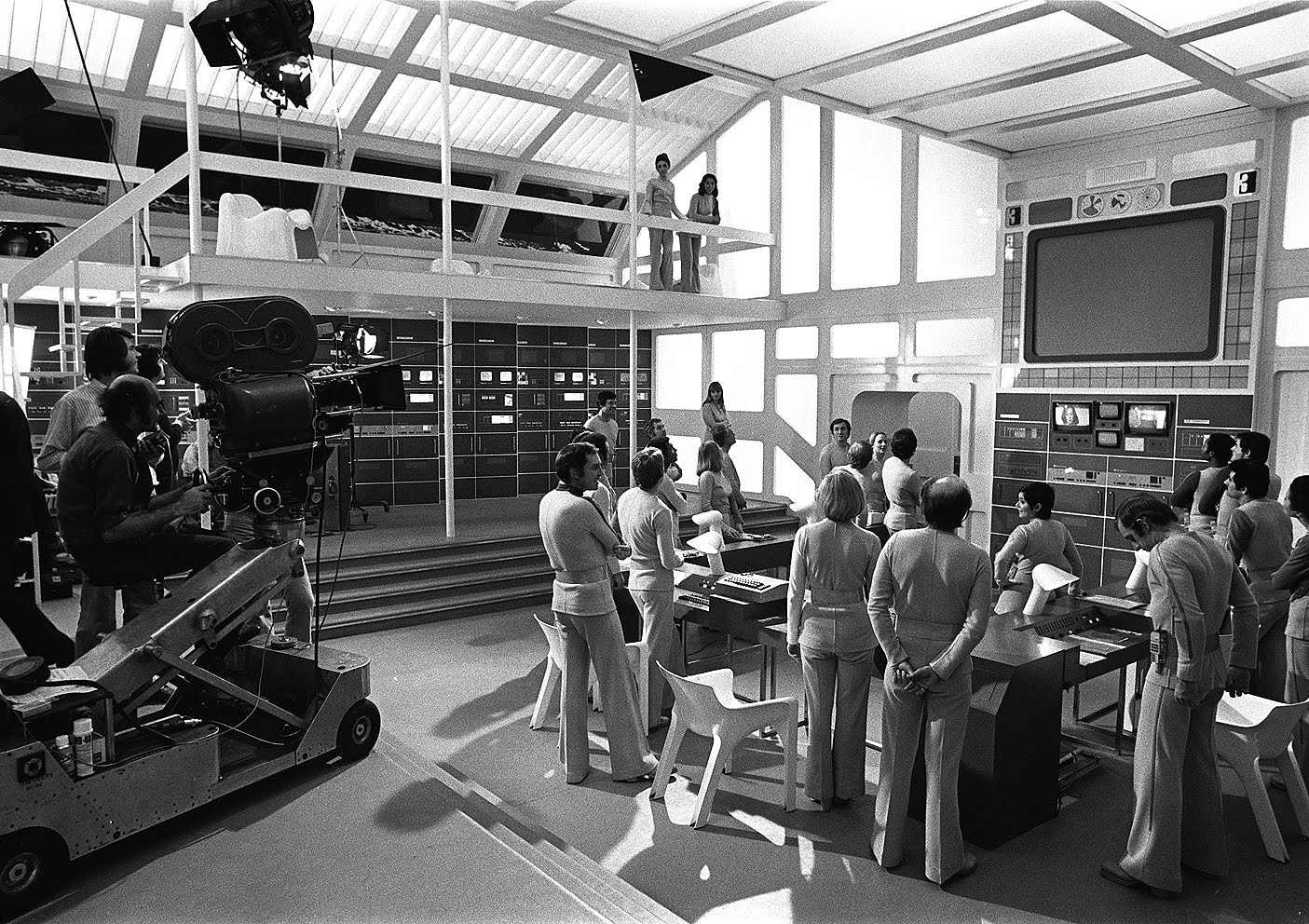
Behind-The-Scenes Pix #37: SPACE: 1999

I'm not sure which episode this is from, but here's a nice production shot of a dramatic scene on the terrific Main Mission set (which both sounds - and looks - so much cooler than Year 2's cave-like "Command Center") from the first season of Space: 1999.

Saturday, December 29, 2012

News: WESTWORLD (1973) & FUTUREWORLD (1976) Coming To Blu-ray In March

Here's some good news for those of us Star Kids who are equipped for HDTV: Warner Home Video will be releasing the 1973 Michael Chricton killer android thriller Westworld, starring James Brolin, Richard Benjamin (Quark) and the unstoppable Yul Brynner (The Ultimate Warrior), on Blu-ray disc in March of 2013.

And in a nice bit of marketing syncronicity, Shout Factory has licensed the rights to the 1976 American-International-produced, Richard T. Heffron-directed sequel, Futureworld, starring Peter Fonda and Blythe Danner (with a cameo by Brynner) and will also be releasing it on Blu in March!

I can't wait! Wouldn't it be extra-cool if Warner Archive would take this opportunity to unearth from the vaults and dust off the short-lived 1980 television series Beyond Westworld at the same time?

Both of these eagerly-anticipated Blu-ray discs are available for pre-order from Amazon:

Westworld [Blu-ray]

Futureworld [Blu-ray]

Tuesday, September 18, 2012

Behind-The-Scenes Pix #26: GENESIS II

Star Trek creator Gene Roddenberry poses on the impressive "PAX subshuttle station" set of his 1973 post-Apocalyptic sci-fi pilot film for Warner Brothers and CBS, Genesis II, starring Alex Cord (Airwolf) and Mariette Hartley.

Genesis II  is available as a manufactured-on-demand DVD from Warner Archive, and I reviewed both the movie and the disc HERE.

Saturday, July 28, 2012

Behind-The-Scenes Pix #23: THE STARLOST

Not the most exciting or dramatic of Behind-The-Scenes photos, I admit, but considering it's from the 1973 Canadian series, The Starlost, I was amazed to find it. I believe this is from the "Space Precinct" episode, and the cramped set really shows what limited resources the low budget production had at its disposal.

I've admitted before that I actually enjoy The Starlost for what it is. Sure, it's not the show it should have or could have been; Harlan Ellison's concept (while not especially original) had tons of potential for a thoughtful, episodic science fiction series. Unfortunately, the bitter reality of economics left that potential unfulfilled, though I'm not sure that any TV production company in '73 could have really pulled it off to Ellison's satisfaction. It is a shame that the Canadian producers couldn't find more writers with actual experience in sci-fi, or secure a bigger budget - but as nonsensical and cheap as it may be, I still enjoy watching episodes on DVD every once in a while.

Wednesday, April 18, 2012

THE STARLOST (1973) That Never Was

I frequently embark on Google safaris, looking for cool stuff to post on the site or images to illustrate the posts I write. In a recent search for material relating to the 1973 television series The Starlost (a show that I still possess an inexplicable affection toward), the image above turned up. Now, I was pretty sure that there had been no Starlost TV novelizations, but that image looked friggin' authentic, so I dug deeper into the labyrinthine depths of the interwebs.

I still haven't determined exactly where this faux book cover originated, but it is definitely a hoax. Still, as a graphic designer myself, I have to give the unknown Photoshop artist his props. The fonts, layout and cover copy text are all delightfully true to the publishing styles of the Seventies. The careful "distressing" of the image works really well, too, adding to the illusion that this is a scan of a vintage paperback cover.

And it's because it is so well done that I decided to share it here. I like to think of it as a glimpse into an alternate universe, where The Starlost was a "runaway hit television series," instead of the creative and commercial disappointment that it turned out to be in this reality....

Thursday, November 3, 2011

THE STARLOST (1973) TV Guide Ads

More vintage TV Guide ads! Here are a couple of advertisements for the syndicated, Canadian-produced 1973 series, The Starlost, starring 2001: A Space Odyssey's Keir Dullea and Gay Rowan. One of the most derided genre series of the Space: 1970 era, I'll admit that it's not a very good show. Still, I find the characters likable and the premise is certainly intriguing - even if rather poorly executed on a microscopic budget.

In fact, I may have to pull the DVD set down off the shelf again someday soon....

Tuesday, August 2, 2011

Virgil Sings!


Okay, this is cool 70s TV novelty. Singer-songwriter Paul Williams performs on Johnny Carson's Tonight Show in 1973 - wearing his full make-up and costume from Battle For The Planet of The Apes, wherein he played the orangutan Virgil. Gotta love the nervous laughter from the obviously confused studio audience! Enjoy.

Sunday, May 22, 2011

STAR TREK Animated PSA


This is a genuine YouTube rarity: a Star Trek public service announcement produced by Filmation Studios for the Keep America Beautiful anti-pollution campaign, from the early 1970s. Featuring the voices of William Shatner, Leonard Nimoy and George Takei.

I remember seeing this when I was a kid!

Sunday, March 27, 2011

Rerun: THE STARLOST (1973)

(This is a re-post of an article originally posted in November of 2009.)

Like many other things in my life, I first discovered the existence of The Starlost through the pages of Starlog magazine in the mid-70's. I learned there that it had been a short-lived 1973 television series created by Harlan Ellison, who, dissatisfied by the final product, had chosen to use his pen name of "Cordwainer Bird" in the credits.

I also knew that Keir Dullea, of 2001: A Space Odyssey, played the lead role of Devon, a young Amish man who discovers that his small world of Cypress Corners is actually an artificial biosphere, one of many that make up the Earthship Ark – a vast multi-generation spacecraft. Venturing beyond his own artificial world, he discovers that a cataclysmic accident several hundred years before killed the command crew of the Ark, and it is now crippled and off-course, heading directly toward a star. With his friends Rachel (Gay Rowan) and Garth (Robin Ward), Devon searches the Ark for some way to correct the ship's course, or for someone knowledgeable enough save it and the millions of people isolated in their own biospheres – most of whom are unaware that they are on a spaceship at all.

And that was about it.

In the late 80's I came across a paperback copy of Phoenix Without Ashes, Edward Bryant's novelization of Ellison's original pilot script for the series. The introduction to the book – by Ellison himself – detailed the series' troubled production and the reasons for the acclaimed author's unhappiness with the show. The novel was pretty good, and piqued my interest, but as the series had only run for 16 episodes and was virtually unseen in syndication, I figured I'd never see the show. Which disappointed me, because I love 70's sci-fi television, no matter how bad its reputation.

Well, considering all the obscurities that have been dug up and released on DVD in the last decade, I should have guessed that somebody would put it on digital disc eventually, and sure enough, the folks at VCI Entertainment have done just that. All 16 episodes of the Canadian-produced show are now available on a compact, 4-disc set.

Produced on a very small budget, the show was shot on videotape and featured modular sets that could be disassembled and reassembled in different configurations to suggest new sections of the vast Earthship Ark. There was also extensive use of chromakey (bluescreen), which enabled the production team to drop the actors "into" miniature sets, which saved even more money. Too bad most of the miniatures were pretty unconvincing.

The videotape filming, sets and costumes give the series a look similar to Doctor Who episodes of the same vintage, but The Starlost doesn't have the same charismatic characters or ambitious storylines and unbridled imagination of Who. In fact, it's pretty mundane all around.

The stories started out okay – if overly cliched – but soon devolved into silliness, with the sort of ludicrous faux science that was common in the era's sci-fi TV. And that's a real shame since some decent guest stars appeared on the show, including familiar genre faces John Colicos (the original Battlestar Galactica, Star Trek), Barry Morse (Space: 1999), Simon Oakland (Kolchak: The Night Stalker), and Walter Koenig (Star Trek, Babylon 5).

Still, I found myself growing somewhat fond of Devon, Garth and Rachel, and I thought that most of the episodes were - at least - entertaining.

Nonetheless, I can completely understand why Ellison disowned the show, and why noted science fiction writer Ben Bova was embarrassed to be credited as the series' "science advisor" – he was completely ignored by the producers, but they kept his name in the credits for the publicity value. Same with special effects ace Douglas Trumbull (2001, Silent Running, Close Encounters of the Third Kind), who quit the show before the first episode was shot, but remained credited as a producer for the entire run.

VCI's DVD set includes all 16 episodes on 4 discs, packed into one standard-sized case. The transfers are sharp and clean, but as noted above, the show was shot on videotape, so the picture quality is far from perfect, with some minor video "noise" and some bleeding colors. It's probably better than it looked on TV in '73, though. The only extra is a presentation reel used to pitch the syndicated series to independent stations before production, hosted by Dullea and Trumbull. In this short film, the series is verbally described by Dullea, accompanied by stock effects shots from Trumbull's then-recent feature, Silent Running.

The Starlost is a classic missed opportunity – with Ellison, Bova and Trumbull aboard, it should have been something remarkable, and revolutionary. Unfortunately, the realities of independent television production, and the bad judgment of the producers resulted instead in an artistic and commercial misfire, interesting only to die hard fans of 70's genre television like myself.

If you consider yourself such a fan, then VCI's set is worth checking out. Buy it from Amazon here: The Starlost - The Complete Series

Friday, March 25, 2011

STAR TREK ANIMATED SERIES (1973) Home Video Artwork

This art - by an unknown (but vaguely familiar) artist - graced the VHS packaging for Paramount Home Video's releases of Filmation's Star Trek - The Animated Series during the late 80s-early 90s.

It doesn't look like anything actually created at Filmation in the 70s; it's a bit too dynamic to have come out of that studio, and the Enterprise appears to be based on the feature film version of the NCC-1701, rather than the cartoon version. Also, what's with the pirate boots?

I'm guessing that it was probably something commissioned specifically for the VHS releases by Paramount. In any case, I think it's a great piece of Trek artwork! Colorful, exciting and really capturing the Star Trek feel.

Tuesday, March 22, 2011

GENESIS II (1973)

"My name is Dylan Hunt. My story begins on the day on which I died." 

In the early 1970s, Star Trek became an unprecedented success in television syndication. Though not considered a success during its initial network run (despite surviving for three seasons), the unexpected - and unexpectedly profitable - popularity of Trek in the after-market and as a merchandising bonanza, surprised more than a few TV executives, and changed their perception of the show's creator somewhat. After several years as something of a TV industry pariah, Gene Roddenberry now found himself to be a desirable commodity... if he could deliver another cash machine like Star Trek.

Well, he gave it a shot - several times.

Warner Brothers Television and CBS decided to give him his first chance, and financed a science fiction pilot film called Genesis II. The premise borrowed liberally from the old Buck Rogers movie serial as well as from Trek - but eschewed the exotic outer space locales prominent in those sources,  and the expensive special effects that they would have required.

The story begins in 1979, where, deep in a government facility built in Carlsbad Caverns, NASA Scientist Dylan Hunt (Alex Cord) is the subject of a suspended animation experiment. Unfortunately, the experiment has just begun when a tremor triggers a cave-in that  buries his hibernation chamber under tons of rock.

In 2133, the chamber is uncovered and Hunt is revived by members of a community called PAX - descendants of survivors of a nuclear war who have made the Caverns their home. The leaders of PAX (as their name would suggest) claim that they are a pacifistic society that works to preserve human civilization.

Hunt is placed in the care of Lyra-a (the lovely Mariette Hartley), a member of PAX who joined them from a mutant race known as Tyranians. The Tyranians are genetically superior to humans, with double circulatory systems (like Time Lords!) and thus, two navels.

Although suspicious of her, the PAXians are unaware that she is a spy for her people, and whenever they're not around, she works to discredit PAX to Hunt. She actually manages to convince him that they're bad guys - and he's rather easily convinced, because, like most Roddenberry heroes, Hunt's a horndog, and Lyra-a is the hottest chick in the cave - and they "escape" from the PAX complex via the high-speed underground subshuttle, which was part of the 1979 Carlsbad facility, and is somehow still working.

Anyway, to make a long synopsis short, Hunt discovers that the mutant Tyranians are (imagine!) a decadent, evil race that keep humans as slaves and their only interest in Hunt is in his value as a scientist. Their city is powered by a 20th Century nuclear generator, and they need Hunt to repair and maintain it. Hunt is rescued by an undercover team from PAX - one of many teams that the PAX group sends out to secretly "help" other post-Apocalyptic societies - and with their assistance, starts a slave revolt before escaping the Tyranian city....

The show possesses a lot of Roddenberry hallmarks, like a sometimes creepy preoccupation with sex (it isn't spelled out, but it's clear that sexual stimulation is required to bring Hunt out of his hibernation state, which is why Lyra-a got the job as his nurse), and the idea that the war-ravaged Earth is now divided into a multitude of isolated, diverse cultures - each of which can be used to comment on some modern-day issue. But it also exhibits an interesting reversal of Star Trek's "Prime Directive;" whereas Kirk & company were expressly forbidden to interfere in the development of other cultures, PAX instead sees themselves as 22nd Century Mary Worths, with  a  responsibility to "guide" (even through covert infiltration and acts of subversion) other societies toward their idealistic, pacifistic view of "civilization."

It's an interesting - if morally questionable - premise, with a lot potential to be explored in an ongoing series.

 The look/production design of the show isn't bad. The citizens of PAX are shown wearing very "Earthy," almost Medieval peasant-looking clothes, while the Tyranians favor pseudo-Roman togas. The Carlsbad Cavern setting for PAX is rather nicely designed, with colorful stalactites and stalagmites, and the subshuttle is a cool-looking transport.

Upon my most recent viewing of Genesis II, however, I was struck by how much Roddenberry's pilot borrowed from the 1939 Buck Rogers serial produced by Universal Studios. Not only do both storylines deal with revived 20th Century men in a post-Apocalyptic Earth setting, but both feature good guys living in a hidden underground mountain complex, bad guys (who keep slaves) living in a futuristic city... and the Buck Rogers serial even features the characters using an underground subshuttle similar to the one seen in Genesis II (the Buck shuttle was located on Saturn, but, still)! Hmmm...

Unfortunately, in a repeat of his experiences in trying to sell Star Trek a decade before, the network found the Genesis II pilot "too cerebral," and, as directed by veteran John Llewellyn Moxey, too talky and lacking in action (although, to fair, the climactic slave revolt is pretty well staged and shot). They also found lead Alex Cord to be too intellectual, and lacking the charisma desired in a TV series hero. CBS passed on the show, choosing instead to go with Fox's small-screen version of Planet of the Apes

But Warner Brothers seemed to still have some faith in Roddenberry and his concept, and persuaded ABC to finance a second pilot, this time called Planet Earth, the following year. (I'll be covering that one when my disc arrives next week).

The DVD-R of Genesis II from Warner Archives is extraordinarily good-looking, even on my HD-TV. The 1.33:1 "full-frame" transfer is remarkably strong, considering its age, with virtually no distracting print damage or dirt. Colors are bright, and details are sharp. No extra features are provided.

The Warners archive site still doesn't accept my debit card, so I ordered it through a third party dealer at Amazon. Even with shipping, I got a brand-new, unopened disc for about the same price as buying it directly from the Warners Archive site.  You can buy it direct from Amazon, too, of course: Genesis II

Dylan Hunt will return... in Planet Earth, the second installment of the "PAX Trilogy!"
 

Thursday, February 3, 2011

February's Space Babe: Gay Rowan

February's Space Babe is the lovely Gay Rowan as Rachel, from the 1973, Canadian-produced television series The Starlost. As a member of an Amish-like community who follows the man she loves into exile, forced to face the startling revelation that her world is just an artificial biosphere - one of many - on a gigantic space ark, Rowan's Rachel always exhibited a sense of wonder, a warm heart, and admirable bravery... all of which made her extremely appealing. The scripts and production values didn't usually give her or her co-stars (Keir Dullea and Robin Ward) much of an opportunity to showcase their talent, but Rowan was always likeable and came off well.

The Canadian actress was born in 1948 and had a few small roles in Canadian and American TV series for about ten years ('73-'83), but as far as I (and the IMDb) can tell, The Starlost seems to have been her only regular series role, and she hasn't made any film or TV appearances in almost 30 years. It's too bad. As I mentioned above, she was a very appealing young woman, pretty and intelligent, and deserved a bigger career. I wonder what became of her?

Friday, November 19, 2010

THE STARLOST (1973) Movie: "The Beginning"


Like many other sci-fi shows from the era (Battlestar Galactica, Planet of the Apes, Space: 1999) several episodes of the Canadian series The Starlost, were also edited into TV movies for syndication. Apparently these cobbled-together telefilms didn't get much airplay in the U.S., but ran for years and years in Canada.

This is the opening narration and credits for the first of these, "The Beginning," which incorporated the episodes "Voyage of Discovery" and "The Goddess Calabra," which guest starred Space: 1970 favorites John Colicos and Barry Morse!